Loading

Monday, February 16

8 ways to remain financially safe in this present market situation


What does it mean to be financially responsible? It's a complex question with a complex answer, but at its core is a simple truth: To be financially responsible, you need to live within your means. And to live within your means, you must spend less than you make!

Credit cards and debt
Sorry - if you're really looking to be financially responsible, just being able to make your credit card payment doesn't cut it. In fact, the fact that you have a credit card payment at all and aren't able to pay your balance in full shows that you already spend more than you earn. Responsible use of a credit means paying the balance on your account in full each month.

And (this part will hurt) credit cards should be used for convenience, not to make ends meet. Credit cards are handy because they eliminate the need to carry cash - you can even generate reward points. And credit cards can be very helpful in an emergency. That said, if an emergency does force you to carry a balance on your card, living in a financially responsible manner means curbing your spending until that balance is paid off.

The same logic applies to all recurring payments that involve paying interest. Think about: Paying interest on anything means that you are spending more for that item than the purchase price. Does that sound like the most responsible choice, or just the most convenient? When the interest payments are factored in to the purchase price, you are spending more to obtain the item than even the item's manufacturer thought it was worth.

As such, avoiding paying interest on anything should be a major objective. Of course, when it comes to the cost of housing and transportation, avoiding interest is almost impossible for most of us. In such situations, minimizing the amount you spend in interest each month is the most responsible action.

Acting in your own best interest
For many people, cutting down on interest and borrowing is easier said than done, but in practice, it really comes down to knowing the difference between necessities and luxuries. For example, you might need a car, but you don't need a luxury sedan and, unless you can afford to pay for it in cash, you shouldn't be driving one.

Likewise, you might need a place to live, but you don't need a mansion. And, although most of us must have a mortgage in order to afford a home, purchasing a home in a financially responsible manner means that you should purchase one that won't break the bank.

In financial terms, this means it shouldn't cost more than two or 2.5- times your yearly income. Another healthy estimate is that your monthly mortgage payment should not cost more than 30 per cent of your monthly take-home pay.

In addition to avoiding overspending on your home purchase, you should make a down payment that is large enough to eliminate the requirement of having to pay for private mortgage insurance. If you can't afford to meet these purchasing guidelines, rent until you can afford to buy.

Paying yourself first
Spending every dime that you earn is simply irresponsible unless you have a massive trust fund that is so flush with cash that you will never outlive the earnings. For most people, especially those of us hoping to retire someday, saving is an activity that must be taken seriously.

A great way to do this is when you get your paycheck - and before you pay your bills - pay yourself first. A good goal to save is 10 per cent.

When it comes to saving, investing in the stock market might be the most profitable choice available. Sure, investing involves risk, but taking calculated risks is sometimes a necessity. The responsible way to go about it is to have a plan.

Start by examining asset allocation strategies to learn how to choose the right mix of securities for your investing strategy. From there, contribute to your employer-sponsored savings plan if such a plan is available. Most plans offer to match your contributions up to a certain percentage, so by contributing at least enough to get the match, you earn a guaranteed return on your investment.

If your finances permit, maximize your tax-deferred savings opportunities by contributing the full amount that the plan allows. After you've started investing, monitor the progress that you are making toward your goals and rebalance you portfolio as necessary to remain on track.

Emergency fund
Financial responsibility means being prepared for the unexpected. Most experts agree that you need to be able to support yourself financially for at least six months without an income. If you are married and used to living on dual incomes, this means being able to pay the necessary bills such as the mortgage, food and utilities on one income - or even neither income!

If a missed paycheck would ruin you financially, it's time to create an financial escape hatch to prevent this.

Don't worry about the neighbours
Financial responsibly means doing what you have to do to take care of your needs and the needs of your family. To make this happen, your focus should be internal. The neighbors aren't paying your bills, so their spending habits shouldn't dictate yours or set the bar for your standard of living.

Budgeting
Having a budget is one the core pillars of financial responsibility. You should know where your money is going. Business owners know the importance of understanding their cash flows and balance sheets; as a result, no successful business exists without a budget. Neither should you.

A very personal definition
Does being financially responsible mean that you have to scrimp and save? Maybe, but only if that is what it takes to live within your means. On the other hand, if you are the Sultan of Brunei, you may easily be able to afford a jet, a mega-yacht, a mansion in the South of France and a few palaces.

Although those of us with lesser means might frown on this extravagance, it shouldn't be confused with a lack of financial responsibility. After all, there's nothing irresponsible about buying things you can afford to pay for.

Arriving at 'responsible'
Ultimately, financial responsibility means living within your means, regardless of the level of those means. So take a close look at your financial situation, evaluate you earning and spending habits, and make the necessary adjustments to put yourself on responsible financial footing.


--
Ujjwal Panda

A Satyam employee writes, from the heart

This article, which has been doing the rounds on the Internet, has been written by an unnamed Satyam [Get Quote]employee.

At a time when almost 90 per cent of my Satyam friends are cribbing about the fraud and betrayal by (former Satyam chairman) B Ramalinga Raju, I have a slightly different opinion.

I know it is bold of me to write this in black and white, but this comes straight from my heart, and experience.

Let me start by quoting an example from 2006. Most of my friends were unemployed, with 50-60 per cent plus marks, with a B.Tech degree from an average university, and madly hunting for a job. Whether people accept it today or not, the truth is that Satyam was the ONLY saviour and the only mass recruiter who was ready to accept students who had backlog. It also did not put a very strict 'minimum-marks' criterion.

And this was true not only for my small college in Lucknow, but also many such colleges across India.

Satyam is the fourth-largest IT company in India. Looking at India's population and the rising unemployment, I really want to thank Raju for giving some 54,000 Indians jobs at least for all these years.

He was the reason for the revival of confidence and the reason for the bread-and-butter for many a family.

Also, Satyam training was renowned all over India. The STC (Satyam Training Centre) created numerous love stories and unexpected rekindling of a youthful environment where girls and boys were more independent than in their colleges.

I remember most of my Satyam friends felt that they made better friends during Satyam's three-to-six month training than they did in the four years of studying B.Tech.

Unfortunately people forget to thank God in sad times. I know what Raju did is deplorable, and unpardonable. He should have treated the business more formally, and not dealt with it like it was his family affair.

He should have straightened up at least a couple of years ago. Why did he hire so many non-potential candidates and keep them on the bench? When were the managers last told that if they don't work hard, they will lose their job? Business cannot be run in such a lousy fashion.

I have a lot of friends at Satyam, both male and female. Moreover I network a lot and thus am fairly well clued into what is happening at the company.

I have seen how people tailgate to Satyam, how they give their cards to others to be swiped on their behalf, how female employees have gone home sharp at 6 p.m., irrespective of when they landed at the office. . ., how employees sit at home for months at a stretch, prepare for all kind of post-graduate entrance exams and still enjoy a full month's pay, how often they went for movies at local theatres at office hours, how often employees went to office just to sign on registers in the mornings and the evenings, how often they faked their health certificates, how often they put unlimited fake medical and house rental bills. . .

How can we blame just one man when EACH AND EVERY person was disloyal? How can we exclude the auditors like PricewaterhouseCoopers? How can we exclude the then board of directors who tried to wash their hands off of the whole affair?

How can we exclude banks who gave hefty loans without true verification? How can we exclude the Andhra Pradesh chief minister who was lenient towards Raju ahd his fellow businessmen? How can we exclude the managers who were never able to trace which bench employee under him had been away from office and for how long?

Yet, how can people forget this is the same man whose ideas and potentials gave them an identity for the past several years? How many couples found the right match at an IT industry, courtesy Satyam, and how many Andhra farmers benefited from their huge investments in Satyam shares.

How can people forget that Satyam launched its offices right at the doorsteps of a residential colony, where people could simply walk to work?

The most gruesome experience that I had was when a Satyam tag wearing person was waiting to attend an interview and I overheard him saying that he was in a business meeting at the MyHome Satyam office when he was sitting right in front of me in a totally different company (little knowing that I too was a Satyam employee).

When employees themselves show such a lousy attitude and don't care a damn for the brand they carry around their neck, how can they expect others to care?

I am not saying that ALL Satyam employees are bad. I have known very dedicated people too, but my point is simple: before pointing fingers at others, introspect a bit. There are thousands of people who have completed certifications at the cost of Satyam, got trained at Satyam, got better jobs because of Satyam. . .

What Raju did was to keep the business of Satyam going at any cost. I see a smart man in him when he realised that it would be better to accept his mistake than be caught and tried under American laws.

I see a selfish father in him too that he put a lot at stake for Maytas. However, he resigned with dignity: it does take courage to accept your mistake in public.

But one cannot deny that he did create employment, which led to many others benefiting too: the tiffinwallahs, the transport people, those who rented their houses, etc.

Today Satyamites call Raju a fraud.

Well, the true and loyal Satyamites surely have all the reasons to call him a fraud. But the rest, who sucked every rupee out of Satyam without doing any value-addition, need to ask themselves: who is the bigger fraud?


--
Ujjwal Panda
State manager I ICMAS
Abacus brain Study pvt.Ltd
Road no-10 I Banjara hills I Hyderabad

5 tax-planning tips for salaried people

With the tax-planning season about to end, most individuals are rushing around to make investments to minimise their tax liability. It has been observed that individuals (often salaried ones) end up paying more taxes than they are obligated to.

While lack of sufficient time to conduct the tax-planning exercise is a reason, largely, this can be attributed to lack of awareness about different incentives, allowances and rebates under the Income Tax Act. Apart from the Section 80C deductions which are quite popular, there are various other sections which can help salaried individuals save taxes.

We believe there is a need for salaried individuals to devote adequate time and effort to the tax planning exercise and be aware of the various benefits that they can avail of. In this article, we present 5 tax-planning tips that can aid salaried individuals minimise their tax liability.

1. Utilise the entire Section 80C deduction

Under Section 80C, the maximum deduction available is Rs 100,000 pa. Ideally, salaried individuals whose gross total income is equal to or more than Rs 250,000 should utilise the entire Rs 100,000 limit.

Consider the case of an individual whose taxable income is Rs 600,000 and who only utilises half of the available Rs 100,000 limit. He would end up paying an additional tax of Rs 15,450 as opposed to an individual with the same taxable income, but has utilised the entire limit.

Also, at times, individuals make investments of over Rs 100,000 in Section 80C designated avenues, since they fail to understand that the benefits are capped. For example, despite making investments of Rs 70,000 in Public Provident Fund and Rs 40,000 in ELSS, the amount eligible is only Rs 100,000.

Following investments/contributions qualify for Section 80C deductions,

  • Public Provident Fund
  • National Saving Certificate
  • Accrued interest on National Saving Certificate
  • Life Insurance Premium
  • Tuition fees paid for children's education (maximum 2 children)
  • Principal component of home loan repayment
  • Equity Linked Savings Schemes (ELSS)
  • 5-Year fixed deposits with banks and Post Office
(The above list of investment/contributions is not exhaustive. For a complete list, please consult a tax- advisor)

2. Think beyond Section 80C

For salaried individuals whose gross total income exceeds Rs 250,000 pa, deductions under Section 80C may not be sufficient to reduce the overall tax liability. In such cases they can consider the following:

Home loan: Individuals intending to buy a house should consider opting for a home loan. Interest payments of upto Rs 150,000 pa are eligible for deduction under Section 24.

Medical insurance: An individual who pays medical insurance premium for self or spouse/dependent children is allowed a deduction of upto Rs 15,000 pa under section 80D.

An additional deduction of up to Rs 15,000 pa is allowed for premium payment made for parents. In case the parents are senior citizens, then the maximum deduction allowed is Rs 20,000 per year.

Donations: Subject to the stated limits, donations to specified funds/institutions are eligible for tax benefits under Section 80G.

Salaried individuals who plan to pursue higher education should avail of an education loan as the entire interest is eligible for deduction under Section 80E. The loan can be for self, spouse or child from an approved charitable institution or a notified financial institution.

3. Restructure the salary

Restructuring the salary and including certain components can go a long way in reducing the tax liability. Unlike eligible investments which lead to an additional cash outflow, restructuring the salary is a more 'efficient' means of claiming tax benefits. The following can form a part of one's salary structure:

  • Food coupons like Sodexo and Ticket Restaurant; they are exempt from tax up to Rs 60,000 per year.
  • Medical expenses which are reimbursed by the employer are exempt up to Rs 15,000 per year.
  • Individuals living in a rented accommodation should have House Rent Allowance (HRA) as part of their salary.
  • Transport allowance is exempt upto Rs 800 per month.
  • Leave Travel Allowance (LTA) can be claimed twice in a block of four years for domestic travel.

    4. Claim tax benefits on house rent paid

    Salaried individuals can claim rent paid by them for residential accommodation, if HRA doesn't form part of their salary. This deduction is available under Section 80GG and is least of the following:

  • 25% of the total income or,
  • Rs 2,000 per month or,
  • Excess of rent paid over 10% of total income

    Please note that the above deduction will be denied if the taxpayer or his spouse or minor child owns a residential accommodation in the location where the taxpayer resides or performs his office duties.

    5. Opt for a joint home loan

    As discussed earlier, the principal repayment on a home loan is eligible for a deduction of up to Rs 100,000 pa and the interest paid is eligible for a deduction of up to Rs 150,000 per year.

    In cases where the home loan is for a substantial sum, it is not uncommon for the interest and principal repayment to exceed the stated limit. To ensure that the tax benefit is optimally utilised, an individual can consider opting for a joint loan with his spouse or parent or sibling.

    This will ensure that both the co-owners can claim tax deductions in the proportion of their holding in the loan. The co-owner falling in the higher tax bracket should hold a higher proportion of home loan to ensure that the tax benefits are maximised.

    Benefits of tax-planning
    Income (Rs) Tax Rate (%) Maximum tax savings
    after 80C deductions
    (Rs)
    Savings invested 
    @ 8% pa for 20 years
    (Rs)
    Savings invested
    @ 15% pa for 20 years
    (Rs)
    Upto 150,000 Nil - - -
    150,001-300,000 10 10,300 48,008 168,575
    300,001-500,000 20 20,600 96,016 337,151
    500,001 and above 30 30,900 144,024 505,726

    As can be seen in the table above, making use of the available tax deductions can go a long way in helping individuals accumulate wealth. Consider the case of an individual in the highest tax bracket with a gross total income of Rs 600,000.

    If he chooses to ignore the tax sops available under Section 80C, his tax liability will amount to Rs 87,550. Conversely, if he chooses to makes eligible investments/contributions of Rs 100,000 under Section 80C, his tax liability will be Rs 56,650 i.e. a saving of Rs 30,900.

    The amount saved in turn can be invested in various avenues like fixed deposits, mutual funds and equities, depending on his risk appetite.

    Given that the tax-planning exercise can aid salaried individuals to both save on tax and accumulate wealth, they would do well to offer the exercise the importance that it deserves.

  •  


    --
    UJJWAl

    How to read a balance sheet-some points


    A balance sheet, also known as a "statement of financial position", reveals a company's assets, liabilities and owners' equity (net worth). The balance sheet, together with the income statement and cash flow statement, make up the cornerstone of any company's financial statements.

    If you are a shareholder of a company, it is important that you understand how the balance sheet is structured, how to analyse it and how to read it. 

    How the balance sheet works

    The balance sheet is divided into two parts that, based on the following equation, must equal (or balance out) each other. The main formula behind balance sheets is:

    assets = liabilities + shareholders' equity

    This means that assets, or the means used to operate the company, are balanced by a company's financial obligations along with the equity investment brought into the company and its retained earnings.

    Assets are what a company uses to operate its business, while its liabilities and equity are two sources that support these assets. Owners' equity, referred to as shareholders' equity in a publicly traded company, is the amount of money initially invested into the company plus any retained earnings, and it represents a source of funding for the business.

    It is important to note, that a balance sheet is a snapshot of the company's financial position at a single point in time.

    Know the types of assets

    Current assets
    Current assets have a life span of one year or less, meaning they can be converted easily into cash. Such assets classes are: cash and cash equivalents, accounts receivable and inventory. Cash, the most fundamental of current assets, also includes non-restricted bank accounts and checks.

    Cash equivalents are very safe assets that can be are readily converted into cash such as US Treasuries. Accounts receivable consists of the short-term obligations owed to the company by its clients. Companies often sell products or services to customers on credit, which then are held in this account until they are paid off by the clients.

    Lastly, inventory represents the raw materials, work-in-progress goods and the company's finished goods. Depending on the company, the exact makeup of the inventory account will differ. For example, a manufacturing firm will carry a large amount of raw materials, while a retail firm caries none. The makeup of a retailers inventory typically consists of goods purchased from manufacturers and wholesalers.

    Non-current assets
    Non-current assets, are those assets that are not turned into cash easily, expected to be turned into cash within a year and/or have a life-span of over a year. They can refer to tangible assets such as machinery, computers, buildings and land.

    Non-current assets also can be intangible assets, such as goodwill, patents or copyright. While these assets are not physical in nature, they are often the resources that can make or break a company - the value of a brand name, for instance, should not be underestimated.

    Depreciation is calculated and deducted from most of these assets, which represents the economic cost of the asset over its useful life.

    Learn the different liabilities

    On the other side of the balance sheet are the liabilities. These are the financial obligations a company owes to outside parties. Like assets, they can be both current and long-term. Long-term liabilities are debts and other non-debt financial obligations, which are due after a period of at least one year from the date of the balance sheet.

    Current liabilities are the company's liabilities which will come due, or must be paid, within one year. This is comprised of both shorter term borrowings, such as accounts payables, along with the current portion of longer term borrowing, such as the latest interest payment on a 10-year loan.

    Shareholders' equity

    Shareholders' equity is the initial amount of money invested into a business. If, at the end of the fiscal year, a company decides to reinvest its net earnings into the company (after taxes), these retained earnings will be transferred from the income statement onto the balance sheet into the shareholder's equity account.

    This account represents a company's total net worth. In order for the balance sheet to balance, total assets on one side have to equal total liabilities plus shareholders' equity on the other.

    Read the Balance Sheet
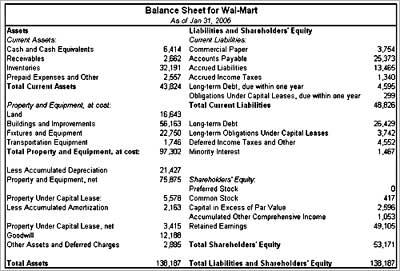
    Below is an example of a balance sheet:


         Source: http://www.edgar-online.com

    As you can see from the balance sheet above, it is broken into two sides. Assets are on the left side and the right side contains the company's liabilities and shareholders' equity. It also can be seen that this balance sheet is in balance where the value of the assets equals the combined value of the liabilities and shareholders' equity.

    Another interesting aspect of the balance sheet is how it is organized. The assets and liabilities sections of the balance sheet are organised by how current the account is. So for the asset side, the accounts are classified typically from most liquid to least liquid. For the liabilities side, the accounts are organized from short to long-term borrowings and other obligations.

    Analyse the balance sheet with ratios

    With a greater understanding of the balance sheet and how it is constructed, we can look now at some techniques used to analyze the information contained within the balance sheet. The main way this is done is through financial ratio analysis.

    Financial ratio analysis uses formulas to gain insight into the company and its operations. For the balance sheet, using financial ratios (like the debt-to-equity ratio) can show you a better idea of the company's financial condition along with its operational efficiency. It is important to note that some ratios will need information from more than one financial statement, such as from the balance sheet and the income statement.

    The main types of ratios that use information from the balance sheet are financial strength ratios and activity ratios. Financial strength ratios, such as the working capital and debt-to-equity ratios, provide information on how well the company can meet its obligations and how they are leveraged.

    This can give investors an idea of how financially stable the company is and how the company finances itself. Activity ratios focus mainly on current accounts to show how well the company manages its operating cycle (which include receivables, inventory and payables). These ratios can provide insight into the operational efficiency of the company.

    There are a wide range of individual financial ratios that investors use to learn more about a company.

    Conclusion

    The balance sheet, along with the income and cash flow statements, is an important tool for investors to gain insight into a company and its operations. The balance sheet is a snapshot at a single point in time of the company's accounts - covering its assets, liabilities and shareholders' equity.

    The purpose of the balance sheet is to give users an idea of the company's financial position along with displaying what the company owns and owes. It is important that all investors know how to use, analyse and read one.


    --
    Ujjwal Panda
    State manager I ICMAS
    Abacus brain Study pvt.Ltd
    Road no-10 I Banjara hills I Hyderabad

    Sunday, February 15

    Graphology - Handwriting gives idea about yourself


    Graphology - Handwriting gives idea about yourself

    See how your handwriting talks about yourself ....


    *1. *If letters slant to the left: Indicates introspection and a lot ofemotional control.
     
    *2. *If letter slant to the right: Reveals a person who's outgoing,friendly, impulsive, and emotionally open.
     
    *3. *If letters are straight up and down: The sign of someone who'sruled by the head, not the heart.
     
    *4. *Letters that slant in more than one direction: Indicatesversatility and adaptability.
     
    *5. *An erratic slant: Usually means a lack of flexibility.
     
    *6. *Heavy pressure writing (like you can feel the rib made on the backof the paper): The writer is agitated.
     
    *7. *Moderate pressure (the writing is dark, but you can't feel the ribon the other side of the paper): Shows ability to deal with stress.
     
    *8. *Light pressure: Indicates someone who seems to take life instride.
     
    *9. *Tiny letters: Indicate the writer is has somewhat low self esteem but is intelligent.
     
    *10. *Small letters: The hallmark of quiet, introspective types -they're generally detail-oriented and have good concentration.
     
    *11. *Large letters: Sign of a confident, easygoing individual.
     
    *12. *Huge letters: Indicate someone who's theatrical, usually loud,and needs to be the center of attention at all times.
     
    *13. *Wide letters (their width and height are about the same): The mark of someone who's open and friendly.
     
    *14. *Narrow letters: Show someone who's somewhat shy and inhibited but very self-disciplined.
     
    *15. *Letters that don't touch: Indicate an impulsive, artistic,sometimes impractical free thinker.
     
    *16. *Some letters connecting: Means the writer's personality blends logic and intuition.
     
    *17. *All letters making contact: The sign of someone who's highly cautious.
     
    *18. *A curved first mark: Shows a person who's traditional and playsby the rules.
     
    *19. *A straight beginning stroke: Reveals someone who's rigid and doesn't like being told what to do.
     
    *20. *A final stroke straight across: The writer is cautious.
     
    *21. *An end mark that curves up: Reveals generosity.
     
    *22. *Perfect penmanship: The hallmark of a communicative person.
     
    *23. *An indecipherable scrawl: Indicates a person who's secretive,closed-up and likes to keep his thoughts to himself .
     
    ujjwal

    Women will fall for you Smart ways!!


    This is a very famous marketing rule which works equally well with women. Women set quite high standards for themselves and consider every one else beneath them(sorry but i feel its true). To get above her, you need to exceed her expectations. May be thats why when men try to show and do big things for her like: getting her expensive gifts or dinner at some expensive resturant so that it impresses them.
    But for a change of fact its not always true. Things like simple cards, being on time for a date or movie, getting her flowers every time you show up, passionate and steamy calls,even taking her
    out on long drives would bring you up in the priority list etc. 
    Its simple dont promise her you would so many things for her or such big things for her just take her by surprise. Just do simple but innovative things true love appreciate creativity than so called BIG things.
    Most women would like to receive the most attention from their partner. Tell her how much you appreciate her feelings her looks her values etc. Tell people about how amazing and
    beautiful you find her
     esp when she isnt so confident about herself.This will make her feel that you value her even when she isnt at her best.
    On a regular basis too, you should keep on telling her that how different she is from others, what is the reason that you fall for her. Women like to hear what their partner thinks of them. They like to be noticed.Thats a hidden fact they would say they dont like attention but see them blush when you praise her!!! Thus simple acts of noticing her can make you two get closer to one another.
    Showing a woman what you feel for her can get her spinning in your arms. If you wear your heart on sleeves be honest, it can almost be guaranteed that she would do the same. Sharing intimate feelings always helps. Showing your gal, how badly you want her will inspire her more and will open her up in front of you.Tell her that how desperate you have been to meet her.Tell her how important she is dont lie for this please "Women can truly catch true praises and lies" .If you honestly mean it then this can make you win more than half of the battle.
    This does not mean that you cannot do the guy's stuff. You simply need to involve her in the acts that you do, in the decisions that you take. Making her feel honored and a part of your life can get her right in there. Some little acts like asking her toparticipate in certain decisions you
    take,
     discussing some important facts of your life, introducing her as your girl admist your friends or holding her hand in front of them etc.
    Women hate when men copy. However, if you come up with something original and special for her, I am sure she would get crazy for you. Set up some innovative ideas for her birthday, your date or any evening outing and see the magic happening. Be creative dont be mechanical thinking of gifting her so and so would impress her not so happening idea dear rather she
    count you up in the same plate as other guys have been so if wanna go up the priority list be 
    creative think "Hatke".Cracking little funny jokes is essential thats not only to lighten the atmosphere around you but also because girls hate nerds!! they hate people who only talk about themselves or only about work or sorta only about any one particular thing so if you cant talk about variety of things try some jokes ;) easy.
    Making your girl laugh is stupendous, But yap be careful DONT CRACK JOKES ON YOUR GIRL just put some crazy jokes she will find you lovely.
    Just be listening her side of the story, you can become the most sought after man. Put your eyes and ears to what she has to say, respond positively (no blame game please) and IF REQUIRED advise her. I put it in caps bz many men will advise unnecessarily even when not asked here it depends on the kind of problem your girl has and the kind of girl she is if she is facing some very serious problem and she cant find a way outta it you will find that on her face she is afraid advise her then n help her, if the problems are petty something like you feel she
    can handle like some regular office stuff etc give her strength n tell her im sure you can handle this. 
    WOMEN LIKE MEN WHO MAKE THEM FEEL CONFIDENT.So Removing all her fears and insecurity and this would get a boomerang effect.


    Mike Ditka  - "If God had wanted man to play soccer, he wouldn't have given us arms."

    4 A's for Better Relations


    There are 4A's that can actually help you to amplify the amount of love you have in any relationship ( not going by only love please include respect understanding and humanitarian values too)...all upto you how many more alphabets you wish to add i feel like these 4 are simpler one's to apply for all :) 
    so Here they are --


    Think upon i do not mean being available just at the time of need (esp if you have kids)....being available means making them feel comfortable to tell you that they can contact you talk to you and tell you things when they wish to .....for some simple reason that 
    1st kids cant often come up with an explaination of their 
    problem.
    2nd for an adult all of us feel some inhibition to contact the person who says i am busy and still says i am there for you its rather contradictory.

    well most often we dont esp if our wife or kids do the small things they do often for us .....ok or if not then your secretary who without any reason at times listens to your squall??? or to those of your friends who often add more meaning to your life. 
    Life isnt just the same ball everyday like with friction of time it gets eroded and so we need to renew it no way can you change things and still expect same satisfaction.
    Well appreciation esp when little things add more meaning to your life when done regularly are more meaningful and please they feel anybody would call you chivalric its a plain thank u with a smile :)

    Two different words yet each one holds powerful emphasis on relations...Get affected make them belief you care simple connectivity can do that magic tell them how happy you are when you are with them dont let all things be left to be understood at times speak and say to them.

    Well i thought would leave the BEST for the last if you miss this you miss the whole meaning .......
    Be it kids or be it an adult they want to be heard only when you are available, can appreciate them say and feel affectionate towards them...but above all for anything they do (as a mistake) they wish to be ACCEPTED.. 
    As a child make your child feel world wont end if things go wrong initially be there for them to tell them life offers a chance to correct it again but not always so they need to learn rather than simply make them feel low because you feel being a stern parent with no time is more apt NO ITS NOT i am sorry i dont agree.With other relations it applies as well trust can only be established once you know you would be Accepted.
     

    Alanis Morissette  - "We'll love you just the way you are if you're perfect."